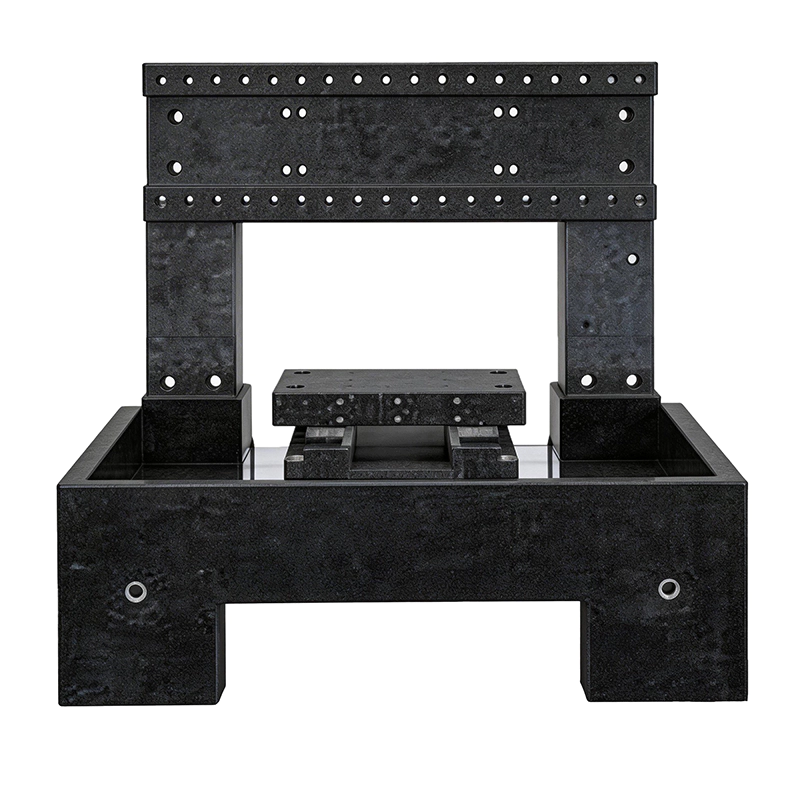
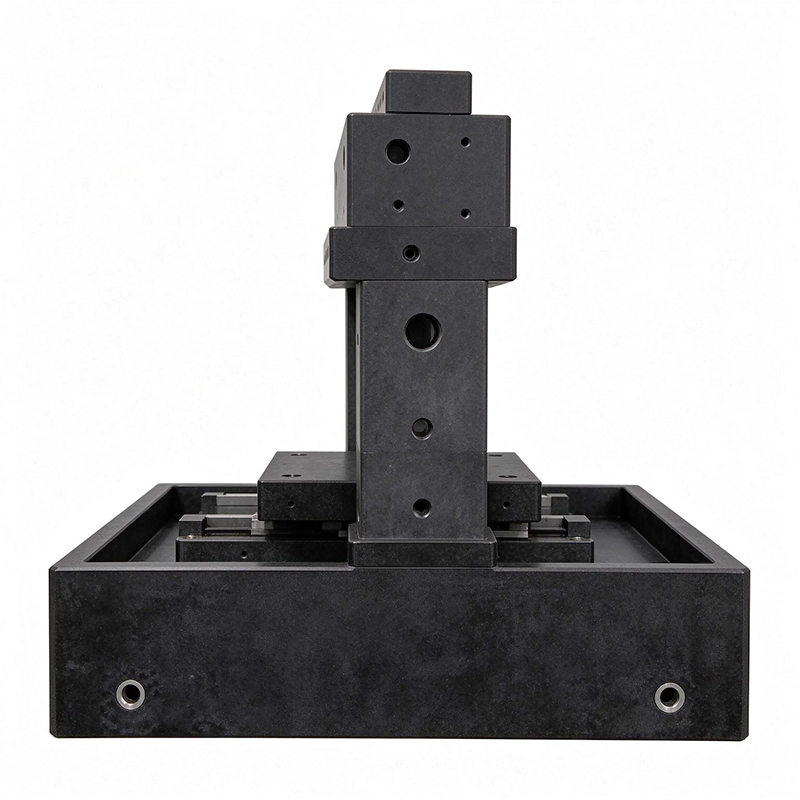
The PMC430 frame — base, gantry supports, lower enclosure and integrated coolant and chip tray — is cast from mineral casting in one unified process, with no bolted-on parts and no weld seams. Steel inserts, anchor points, cable channels and coolant lines are cast directly into the structure.
Unlike a cast-iron frame, a mineral casting frame is poured at room temperature: it carries no thermal internal stress, needs no annealing, and never relaxes over the machine’s life. All guide surfaces are precision-ground after curing, as is the T-slot work table, ground on both sides for maximum flatness, stability and clamping force.
With damping up to 10× that of cast iron and thermal conductivity of only ≈ 1/20 of cast iron, the frame absorbs cutting vibration at the source and reacts slowly and evenly to shop temperature changes — the physical foundation for fine surface finishes and stable accuracy over long, unattended cuts.
The PMC430 frame was verified by finite element analysis (FEM) in three load domains — static stiffness, modal dynamics and thermal behaviour — before the first mold was built. The objective was not only to validate the structure under operating conditions, but to quantify its reserves under significantly elevated loads.
Forces of 1,000 N — several times typical process forces — were applied in X, Y and Z at the gantry interface, with deformations evaluated at the linear-guide mounting points, exactly where the frame must prove its stiffness.
| Load direction | Deformation (FEM) |
|---|---|
| X direction | 0.008–0.014 mm |
| Y direction | 0.006–0.012 mm |
| Z direction | 0.003–0.004 mm |
| Mode | Natural frequency | Mode shape |
|---|---|---|
| 1st | 92 Hz | Gantry rocking in X |
| 2nd | 118 Hz | Column bending in Y |
| 3rd | 143 Hz | Torsion of gantry beam |
| 4th | 176 Hz | Local spindle-head bracket mode |
All structural modes sit well above servo bandwidth and typical tooth-pass excitation, and the frame’s high material damping (logarithmic decrement 0.02–0.03 vs. 0.003 for cast iron) settles residual vibration in a fraction of the time.
Under a uniform +5 K ambient change, simulated spindle-nose drift is ≤ 0.005 mm; under a 2 K top-to-bottom gradient, ≤ 0.006 mm over an 8-hour shift. The frame’s high thermal inertia (specific heat ≈ 2× cast iron, conductivity ≈ 1/20) flattens short temperature swings before they can reach the workpiece.
Conclusion: the FEM verification demonstrates generous stiffness reserves, clean dynamics and thermal calm — a machine that stays dimensionally stable even under extreme loads, providing the foundation for reliable machining with high repeatability, even in dynamic applications.

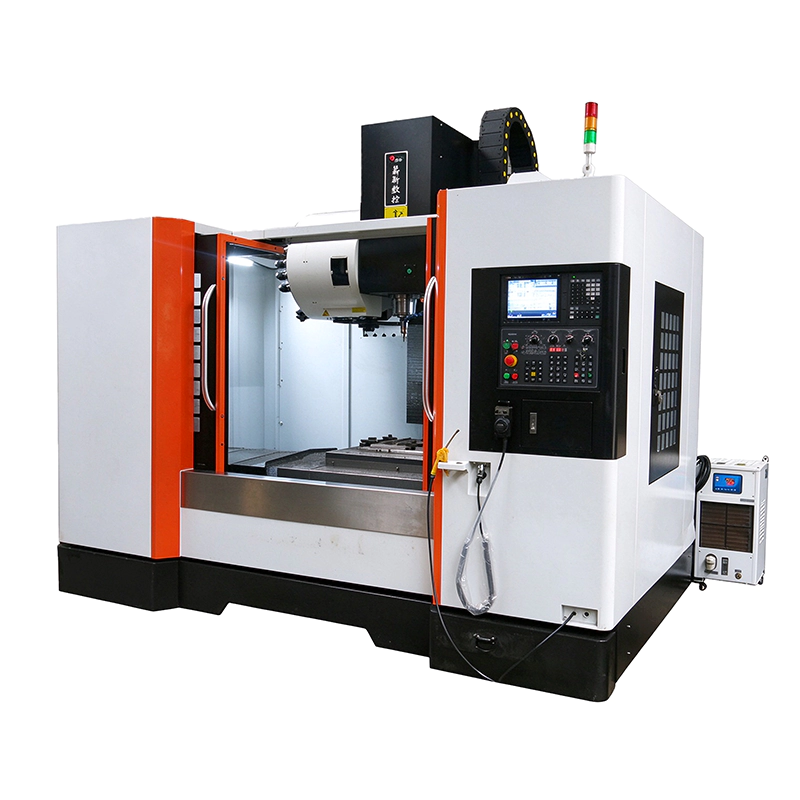
The entire control technology is integrated directly into the machine — no external computer, no separate control cabinet, no cable clutter. A 32-bit 4-axis CNC controller runs fully standalone; an optional touchscreen with mount, fully enclosed housing, safety door switches and an additional emergency stop make the PMC430 equally at home in production, workshops and training facilities.
Spindles are mounted, electrically configured and tuned to the machine as a complete system — choose based on your materials and tooling.
| Parameter | PMC430 |
|---|---|
| Travel X / Y / Z | 430 / 300 / 300 mm |
| Work table | 560 × 320 mm, T-slots, ground both sides |
| Frame | Monolithic mineral casting, cast-in steel inserts, stress-free cold-cast |
| Guideways | 20 mm precision linear rails, ground mounting surfaces |
| Ball screws | C5 ground ball screws, backlash-free couplings |
| Drives | AC servo on all axes |
| Rapid traverse / cutting feed | 15 m/min / up to 8 m/min |
| Positioning accuracy | ±0.008 mm (with linear scales: ±0.003 mm) |
| Repeatability | ±0.005 mm (with linear scales: ±0.002 mm) |
| Spindle | BT30, 3.7 kW, 8,000 rpm (options: high-torque ER32 · 24,000 rpm high-speed) |
| Controller | 32-bit standalone 4-axis CNC, optional touchscreen |
| Workpiece materials | Aluminium, steel, titanium, engineering plastics, composites |
| Machine weight | ≈ 1,450 kg |
| Options | Full enclosure, flood coolant, chip conveyor, 4th-axis rotary table, Fagor linear scales, tool probe |
Share your application, drawing or dimensional requirements with our team.